Automation
Automatic gate operators
Residential and commercial operators installed on a new gate, or retrofitted onto one that is already hanging, plus the service call after.
Chapter 01
The operator usually fails before the steel does
Dust in the cabinet, corroded terminals, a circuit board cooked by a full summer of West Texas sun, or a limit switch that has quietly drifted after a season of the steel expanding and contracting. Those are the failures that actually stop a gate, far more often than a weld letting go or a hinge wearing out.
We run conduit properly instead of letting wire sit exposed to the weather, and we mount the cabinet somewhere it can actually be opened and serviced rather than wherever was most convenient on install day. Limits and safety loops get set with the gate at working temperature, not on a mild fall morning when the steel sits at its most relaxed.
Skip that step and the cost shows up as a gate that opens beautifully in October and stalls halfway through its swing the first hundred degree afternoon in July, because the limits were never set for the steel it is actually moving.
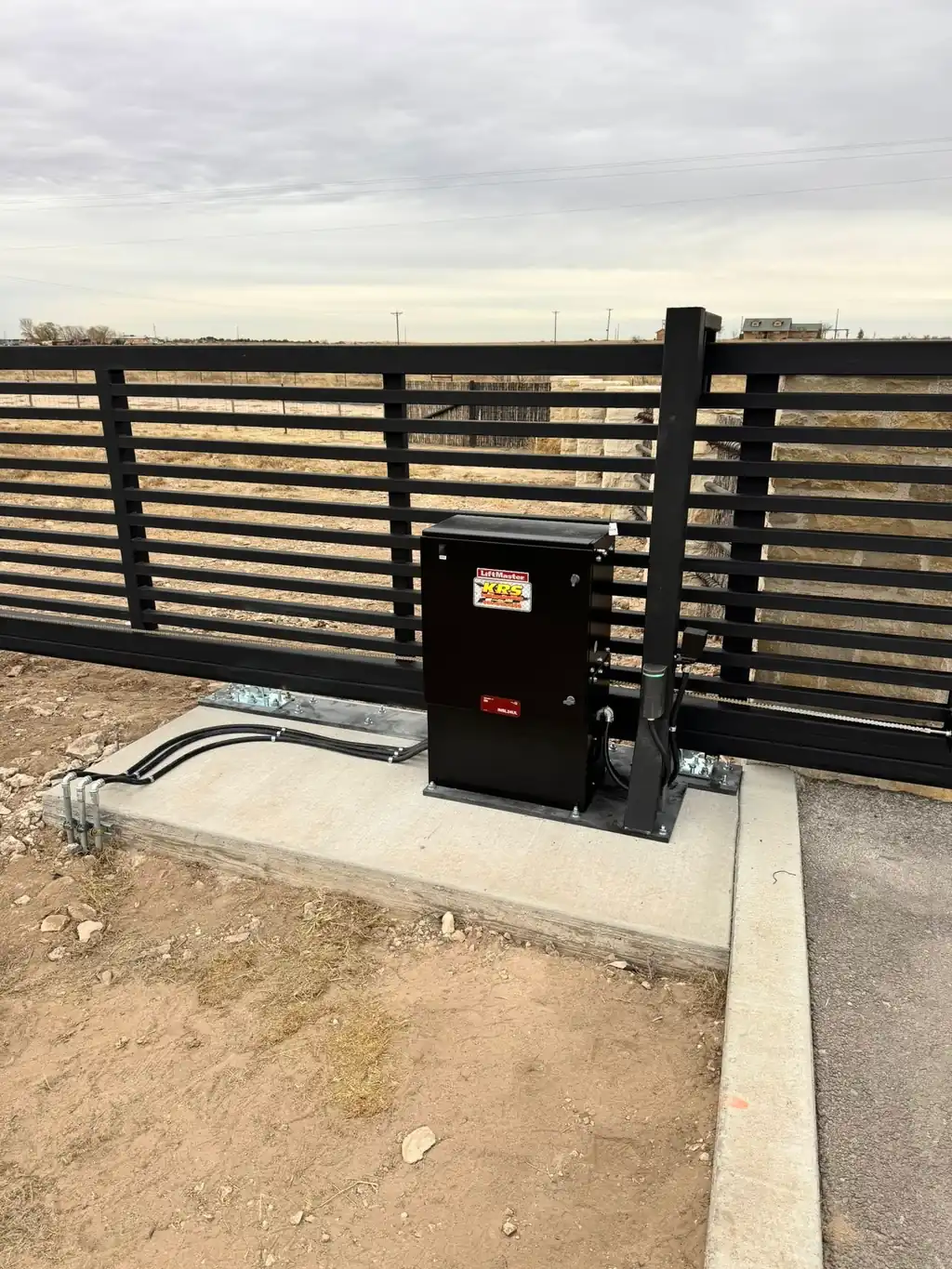
A LiftMaster gate operator carrying the KRS Fabrications sticker, mounted beside a black horizontal-slat slide gate
Retrofitting an operator onto a gate that is already hung
The most common failure in this part of the job has nothing to do with the operator itself. It is automating a gate that is not square, not free running, or hung on a post that was never sized to take a motor pushing against it all day. The operator gets blamed for what is really a hinge problem, or a post problem, or a gate that was built wrong to begin with.
Before we quote an operator, the gate gets checked for true and free travel by hand. If it does not roll or swing freely under a hand push, no operator is going to fix that, and putting one on anyway just moves the strain from a person's arm to a motor that will eventually fail the same way.
A photo of the gate and the post it hangs on is usually enough to tell you what is realistic before anyone drives out from the shop. Skipping that check is how a brand new operator ends up destroying an old gate within a season.
Chapter 03
Service afterward is part of the job, not a separate company
Buying an operator from whoever quoted the lowest number, then having nobody who actually knows the install, is a common way this goes wrong. When the board trips or the gate stops responding, the owner is left calling a manufacturer's support line instead of the person who was standing at the opening the day it went in.
The shop that welded the gate is the shop that comes back for the operator call, which is exactly what shows up in the reviews KRS has on Google. Kelly and the crew are in the shop Monday to Friday, 8 to 5, answering the phone for the same customers year after year.
Skip that continuity and the cost is a gate stuck open at a commercial yard on a Saturday, with a phone number on the sticker that goes nowhere. Closing that gap, service and installation from the same shop, the same people, is most of what this side of the business is.
KRS Fabrications installs and services gate operators for residential and commercial customers across Lubbock and the South Plains. Call the shop weekdays at (806) 548-1260.
What we need before we can quote an operator
- A photo of the existing gate and the post it hangs on, so we can see how it is built and how it travels.
- Whether power already runs to the opening or has to be brought in.
- Roughly how many times a day the gate will cycle. That is different math for a house than a commercial yard.
- Whether this is a new gate going in with the operator, or a retrofit onto one that is already hanging.