Gates
Custom slide gates
Cantilever gates built for the opening you actually have, from a ranch entrance outside Lubbock to a locked commercial yard. Nothing runs across the driveway.
Chapter 01
Why almost every wide opening out here ends up cantilever
A rolling gate depends on a V-track set into the driveway, and on the South Plains that track is fighting the ground the whole time it sits there. Caliche and blowing sand fill the channel faster than most owners expect. The wheel starts climbing debris instead of rolling through it, and once a hard freeze hits in January the whole assembly can seize solid overnight.
Add a low trailer catching the rail on the way through a working property, and a rolling gate turns into a maintenance job nobody signed up for. A cantilever gate moves the track off the ground entirely. It gets welded along the bottom rail of the gate leaf itself, and the rollers that carry the weight sit back on the fence line, out of the path of every vehicle that comes through.
Skip that decision and the cost shows up as an annual fight with a track that keeps filling in, and eventually as a gate somebody just leaves open because closing it has become a chore. On a wide ranch or acreage entrance around Lubbock, cantilever stops being the upgrade option and starts being the only one that keeps working.
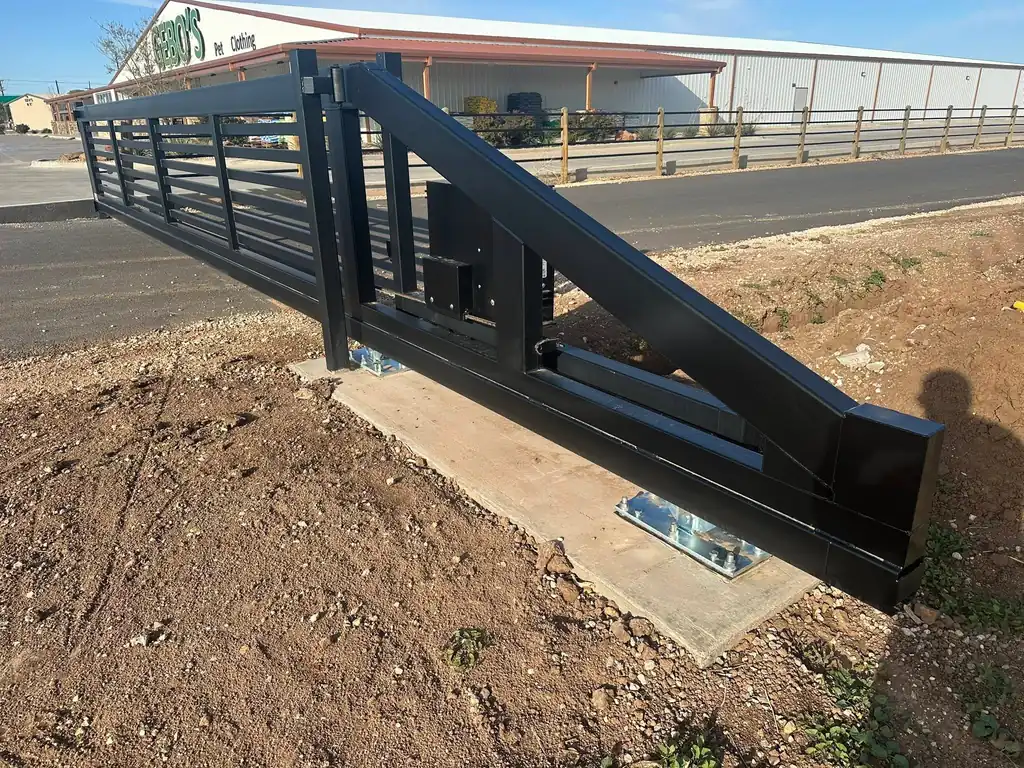
A KRS Fabrications cantilever slide gate mid-installation, the counterbalance truss and baseplates exposed on fresh concrete
The counterbalance is the whole engineering problem
Everything about how a cantilever gate performs traces back to one member: the counterbalance truss that reaches back over the fence line to balance the weight of the leaf hanging out over the open drive. Undersize that truss, or let it go up even slightly out of square, and the leading edge of the gate starts to sag the moment it clears the last roller.
A sagging leaf drags, the operator has to work harder every single cycle, and the roller posts start leaning under a load they were never built to carry evenly. We size the counterbalance tail against the actual clear opening rather than a stock length, and the leaf gets welded square on the bench, checked and rechecked, before it ever goes on a truck.
The roller posts get their own concrete pad, set back far enough that the gate has somewhere to go when it is fully open, because a pad poured short is the most common reason a cantilever gate starts misbehaving in its second year. Get the truss and the pad right and the rest of the gate is mostly upkeep. Get either one wrong and every symptom that shows up later traces back to that first pour and that first weld.
Chapter 03
Infill decides how the gate lives with the wind
Lubbock sits inside the West Texas wind corridor, and a solid, full-height infill panel on an exposed lot is a sail whether anyone meant it to be one or not. Every gust loads the truss, the posts and the operator, and on the South Plains that load is not an occasional event. It is most days from late winter through spring.
We pick slat spacing, picket spacing and panel choice for the site as much as for the look a homeowner wants. A tighter spacing buys more privacy and takes more wind. A more open pattern gives the wind somewhere to pass through and asks less of the truss and the operator over years of daily cycles.
That trade gets made on purpose, in the conversation before the gate is built, not discovered after a spring storm. A gate that looks fine going up in October, calm air, still posts, can spend the next few springs slowly working itself loose at every weld and every bolt: structurally sound in a garage and quietly wearing itself out outdoors.
KRS Fabrications has built cantilever slide gates for homes, businesses and industrial sites across Lubbock and the South Plains since 2004. Call the shop Monday to Friday, 8 to 5, at (806) 548-1260.
What we need before we can quote a slide gate
- The clear opening width, measured post to post if a fence line already exists.
- A photo of the driveway or approach, so we can see the grade and how much room the truss needs on the closed side.
- What has to fit through it: a passenger vehicle, a delivery truck, a stock trailer, and how often.
- Whether you want the gate automated now or built ready for an operator later.