Security Fencing for a Commercial Yard: What Actually Stops a Problem
Most commercial perimeter fencing is a visual deterrent; actual security fencing is built around the specific ways a perimeter fails.
September 3, 2026 · 4 min read
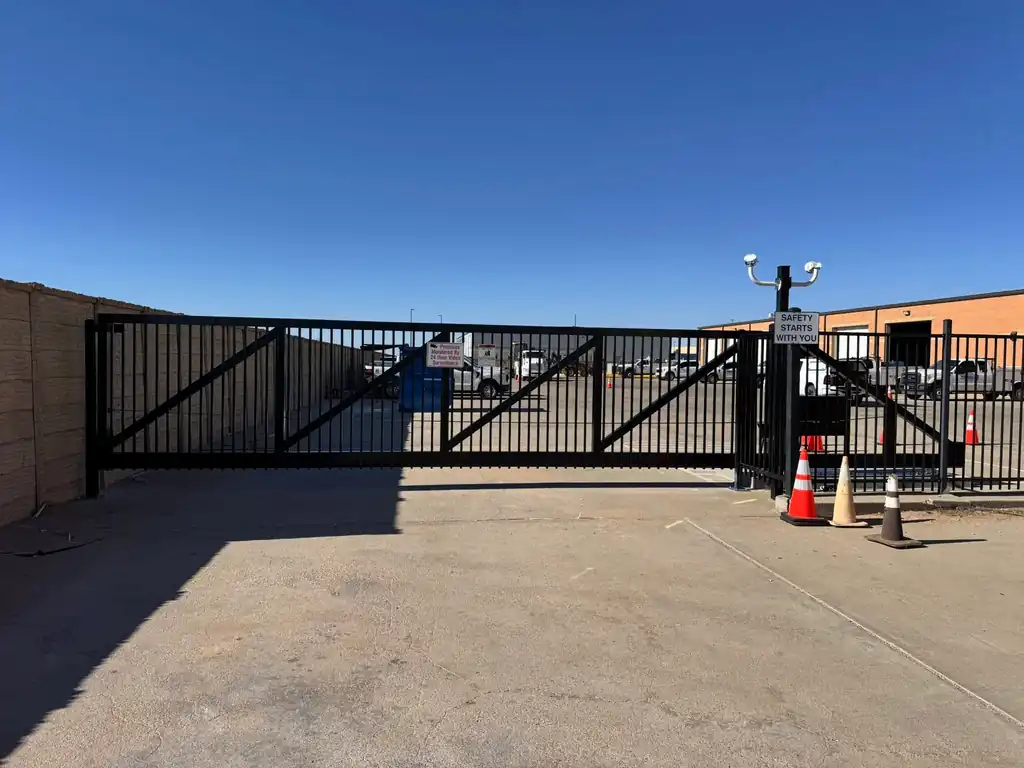
Fencing That Looks Secure Isn't Always Secure
A tall fence with a locked gate reads as secure from the road, but a lot of commercial perimeter fencing is really only a visual deterrent, enough to discourage someone who isn't trying very hard, and not much more. Actual security fencing is a different design problem, one built around the specific ways a perimeter fails, not just around height.
Height Alone Doesn't Do the Job
A fence that's easy to climb isn't much of a barrier no matter how tall it is. Anti-climb mesh, tight enough that fingers and toes can't get purchase, or a picket profile with pointed or spear-top pickets, does more real work at seven feet than a smooth chain-link panel does at ten. The gap under the fence matters just as much as the height. A yard with even a few inches of clearance at grade, especially along a drainage swale or a spot where the ground has settled, gives an easy way under rather than over.
Materials That Resist Cutting
Chain-link, even a heavy gauge, cuts through quickly with a set of bolt cutters or an angle grinder, and it was never designed to resist a determined attempt at entry, only to mark a boundary. Welded steel panel or picket construction takes meaningfully longer to defeat with hand tools, both because the bar stock itself is thicker and because a welded joint doesn't come apart the way a woven or clipped chain-link fence does. That extra time matters more than it sounds like it should, because most opportunistic entry attempts are also time-sensitive. A fence that takes five minutes to breach instead of thirty seconds changes the calculation for anyone without a specific, planned reason to get through it.
The Gate Is the Weak Point
Every perimeter is only as strong as its weakest section, and on a commercial yard that's almost always the gate, not the fence panels. A slide gate on a track with a gap at the bottom, a swing gate with exposed hinges someone could unbolt from the outside, or a gate operator with no lock-out when it loses power, all turn a solid fence line into a perimeter with one obvious point of entry. Camera coverage aimed at the gate opening itself, not just a general yard view, closes a lot of that gap, which is why it's common to see a camera mounted right at the gate rather than off to one side.
Lighting and Sightlines
A perimeter that's hard to see is hard to secure, no matter how good the fence itself is. Solid privacy panels look secure but also block the view of anyone checking the fence line from inside the yard, and they give cover to someone once they're over or through. Fencing that lets sightlines through, paired with adequate lighting along the perimeter and especially at the gate, does more for actual security than a taller, more solid-looking barrier that hides activity from both directions equally.
Fencing That Actually Belongs on an Industrial or Commercial Site
- Welded steel picket or panel construction instead of chain-link where the site handles equipment, materials or vehicles worth protecting
- Anti-climb mesh or spear-top pickets rather than a smooth, climbable top rail
- A slide gate rather than a swing gate where the fence line allows it, for the same wind and reliability reasons that apply to any West Texas gate
- Camera coverage aimed specifically at the gate, not just a general yard view
- Ground-level clearance checked and corrected, not left to settle over time
Not every commercial property needs the same level of fencing. A small retail lot with foot traffic and nothing valuable stored outside overnight has a very different risk profile from an equipment yard holding machinery worth protecting, or a wind energy site with specialized tooling on hand. Overbuilding a fence past what the actual risk calls for wastes money without adding real security, while underbuilding leaves exactly the gap a determined intruder is looking for. Getting that sizing right starts with an honest look at what's actually on the property and how it's used day to day, not a standard spec applied to every site the same way.
Wind energy sites, equipment yards and industrial lots around Lubbock all have different risk profiles, and the right fence for a yard storing heavy equipment looks different from the right fence around a smaller commercial lot. KRS Fabrications has built commercial and industrial gates and fencing across West Texas, including custom tooling for the wind energy industry, and works through what a specific site actually needs rather than defaulting to a standard panel run.
KRS Fabrications — (806) 548-1260
Call (806) 548-1260More articles
Cantilever Slide Gates vs. Swing Gates: What Your Lubbock Driveway Actually Decides
The gate that suits your neighbor's flat, sheltered lot might be the wrong call for a windy, sloped drive a mile down the road.
What a Gate Operator Actually Has to Survive Out Here
The gate itself can go decades; the motor and drive system that opens it automatically is usually the part that fails first.