What a Gate Operator Actually Has to Survive Out Here
The gate itself can go decades; the motor and drive system that opens it automatically is usually the part that fails first.
September 3, 2026 · 4 min read
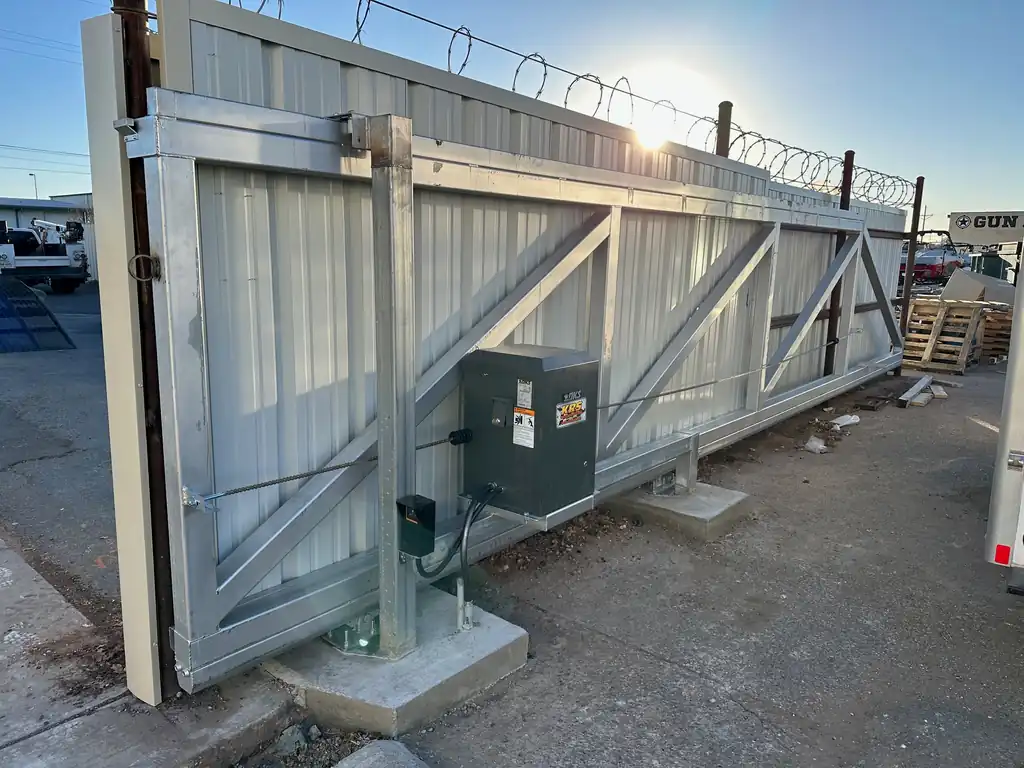
The Gate Usually Outlasts the Operator
A steel gate, built and finished properly, can go decades with basic upkeep. The operator, the motor and drive system that opens and closes it automatically, is the part that usually fails first, and in West Texas it's working against conditions that shorten its life faster than in milder climates. Understanding what the operator is up against helps explain why service calls happen, and what actually causes them.
Dust and Grit
The South Plains kicks up fine dust and blowing sand on a regular basis, and it gets into everything: chain drives, gear housings, photo-eye sensors, the seals around a control box. Grit in a chain drive accelerates wear on every link. A film of dust on a photo-eye lens can make a safety sensor read a false obstruction, or worse, fail to see a real one. Operators rated for outdoor use are sealed against this, but no seal is permanent, and dust exposure is a big part of why gate operators need periodic inspection even when nothing looks obviously wrong.
Not every gate operator sold is actually built for unsheltered outdoor use in a harsh climate. Some are rated only for light residential use with an assumption of moderate weather, and installing one of those on an exposed commercial or industrial gate in West Texas is asking it to do a job it wasn't designed for, regardless of how it performs on paper in milder conditions. Matching the operator's duty cycle and weather rating to the actual site, how often the gate cycles per day, how exposed it is to sun and wind, and whether it's carrying residential or commercial traffic, matters as much as matching the operator's power to the gate's weight.
Heat and Hard Freezes, Back to Back
Lubbock summers push control boxes and motors well past their comfortable operating range, and the grease or hydraulic fluid inside the mechanism thins out under sustained heat. Then winter brings hard freezes, sometimes within the same week as a warm afternoon, and that same fluid thickens; gears that ran smoothly in July can bind in January. Cycling between temperature extremes repeatedly stresses seals, gaskets, and any rubber component in the system more than a steady climate ever would. It's one of the more underrated reasons operators in this region need to be rated and installed for real outdoor duty, not just weather-resistant in name.
Power Flicker and Backup
Rural and semi-rural West Texas properties see more grid instability than dense urban areas: brief flickers, brownouts during storms, the occasional outage that outlasts a battery backup. A gate operator caught mid-cycle during a power flicker can stall in an awkward position, neither fully open nor fully closed, and depending on the model may need a manual release to move the gate by hand until power comes back and the system resets. Battery backup exists specifically for this, keeping the gate operational through short outages, but it has limits, and a property with frequent grid trouble should factor that into which operator gets specified in the first place.
Preventive Maintenance Basics
A lot of operator trouble is preventable with basic upkeep rather than a service call after something fails. Chain and gear-drive components need periodic lubrication, more often in a dusty environment than a manufacturer's baseline schedule might suggest, because grit works its way into grease and starts grinding rather than lubricating once it's contaminated. Photo-eye sensors and their lenses should get wiped down on a regular basis, since a thin film of dust is often the actual cause of a gate that stops for no visible reason. Battery backup units have a service life of their own and lose capacity gradually, so a battery that held the gate through last year's outage might not hold it through this year's without ever throwing an obvious warning first. None of this replaces a proper inspection, but catching small issues on a routine basis is usually cheaper and less disruptive than waiting for the operator to fail outright.
Signs the Operator, Not the Gate, Needs Attention
- Gate moves slower than it used to, or hesitates before starting
- Unusual grinding or clicking from the drive housing
- Photo-eye sensor triggers a stop with nothing in the gate's path
- Remote or keypad works intermittently, but the gate moves fine when triggered manually
- Gate stops mid-cycle and needs a manual release to move at all
Most of these point to the operator and its sensors, not the gate structure itself, which is exactly why a service call sometimes turns out to be a quick fix rather than anything close to a full replacement. KRS Fabrications installs and services residential and commercial gate operators across Lubbock and West Texas, and stands behind the work after installation, not just at the point of sale.
KRS Fabrications — (806) 548-1260
Call (806) 548-1260More articles
Cantilever Slide Gates vs. Swing Gates: What Your Lubbock Driveway Actually Decides
The gate that suits your neighbor's flat, sheltered lot might be the wrong call for a windy, sloped drive a mile down the road.
Powder Coat, Galvanizing and Paint: How Each Ages on the South Plains
Bare steel rusts, and powder coat, galvanizing and paint slow that down in three genuinely different ways.